
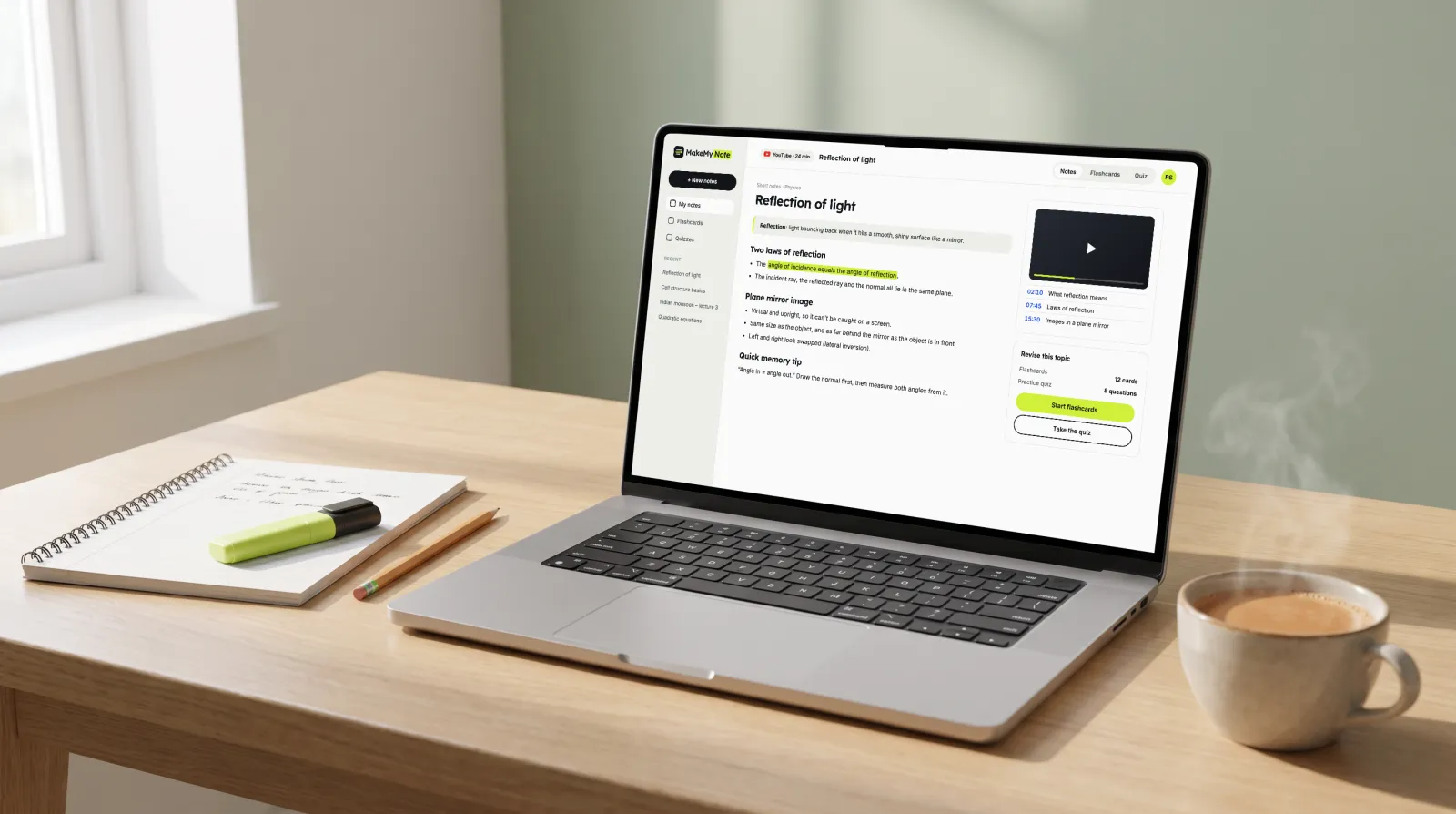
YouTube is one of the best free classrooms in the world. But watching a lecture is not the same as learning it. A week later, most of it is gone, and you end up watching the same video again.
Good notes fix that. Here is a simple way to make notes from YouTube lectures that you can actually revise from, without pausing the video every minute.
1. Know why you are watching
Before you press play, write one line at the top of your page: what do you need from this video? It might be “understand how photosynthesis works” or “the three causes of the First World War”. This one line keeps your notes focused. Anything that does not help answer it can stay out.
2. Watch once at normal speed, writing only headings
On your first watch, do not try to write everything. Just note the main sections as the teacher moves through them. Many lecturers say it out loud: “first”, “the next idea”, “so to sum up”. Those are your headings.
This gives you the skeleton of your notes, and you get the big picture before you get lost in detail.
Tip: If the video has chapters or timestamps in the description, use them as your headings and save yourself the first watch.
3. Fill in the key points in your own words
Now go through each section and add two to four short points under each heading. Keep these rules in mind:
- One idea per point. Long sentences are hard to revise.
- Use your own words. If you can explain it simply, you understand it.
- Write definitions exactly. Key terms are the one place to be precise.
- Highlight one line per section. The single most important idea, like a highlighter in a textbook.
This is where watching at 1.25x or 1.5x speed helps. You already know the structure, so you can skim the parts you understood and slow down where it gets hard.
4. Write a three-line summary
At the bottom of your notes, close the video and write three lines about what it was about, from memory. This is harder than it sounds, and that is the point. If you get stuck, you have found the part you need to rewatch.
5. Turn your notes into questions
Notes you only read are easy to forget. Notes you test yourself on stay. Go through each section and write one or two questions it answers. For example:
- “What does the first law of reflection say?”
- “Why did prices rise after the war?”
- “What is the difference between mitosis and meiosis?”
The next day, cover your notes and try to answer them. You can turn these questions into flashcards, or use the Cornell notes format, which puts them right next to your notes.
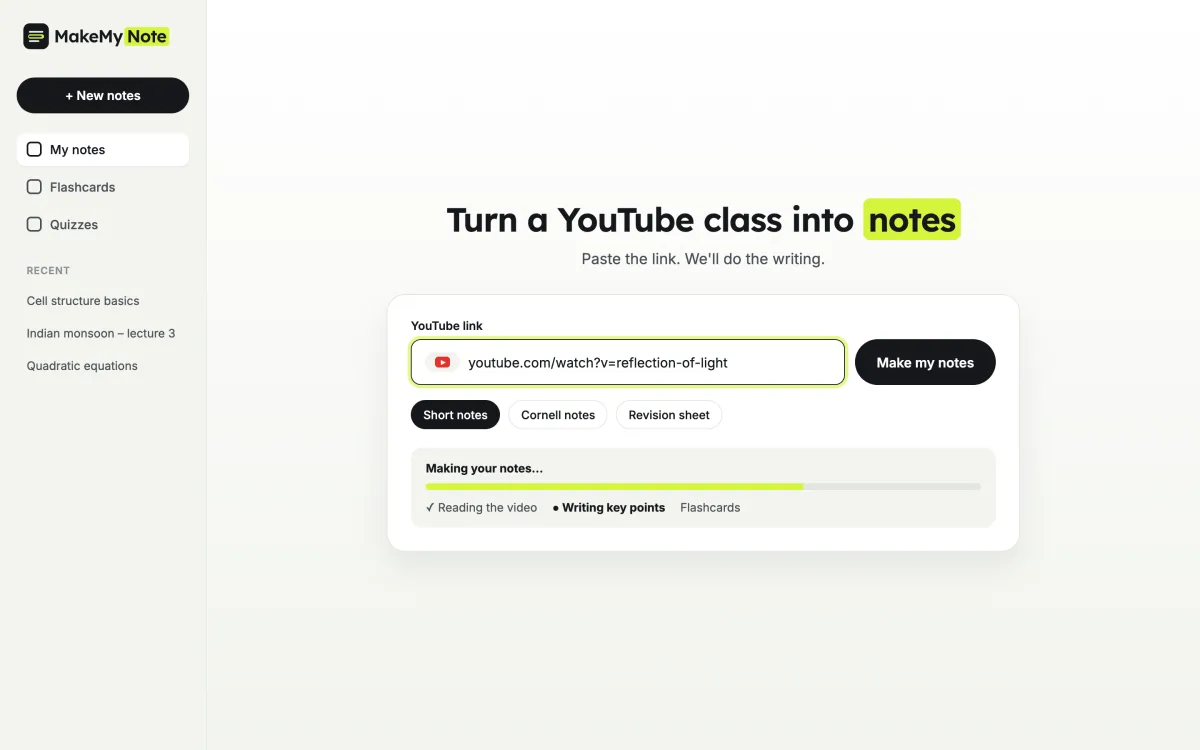
Shortcut: let AI do the first draft
Steps 2 and 3 are where most of the time goes. If you are short on time, you can paste the video link into MakeMyNote’s YouTube to notes tool. It writes the headings, key points and definitions for you, plus flashcards and a quick quiz from the same video.
Use it as a first draft, not a replacement for thinking. Read the notes, fix anything that does not match your course, and still do steps 4 and 5 yourself. That is where the learning happens.
A quick checklist
- Write why you are watching.
- Watch once, noting only headings.
- Fill in key points in your own words.
- Write a three-line summary from memory.
- Turn your notes into questions and test yourself the next day.
Try it on your next online class. One good page of notes is worth more than three rewatches.