
The Cornell notes method is one of the simplest ways to take notes that you can actually study from. It was created by Walter Pauk, an education professor at Cornell University, and it is still used by students everywhere because it does one thing very well: it turns your notes into a self-test.
Here is how the Cornell notes method works, how to set up the page and how to study with it.
How to set up a Cornell notes page
Take a normal page and split it into three parts:
- Cues – a narrow column on the left, about a third of the page.
- Notes – the wide column on the right.
- Summary – a strip across the bottom, about five lines tall.
Write the topic and date at the top. That is all the setup you need.
Step 1: Take notes in the right column
During the class or while reading, write your notes in the wide right column. Keep them short: key ideas, definitions, examples and anything your teacher repeats. Skip a line between ideas so the page is easy to scan later.
Step 2: Write cues on the left
After class, read your notes and write a short question or keyword in the left column next to each idea. The cue should be something the notes answer. For example, next to a note about equilibrium price, you might write: “What is equilibrium price?”
Tip: Questions work better than keywords. A question forces you to recall the answer, a keyword only reminds you of it.
Step 3: Summarise at the bottom
In the bottom strip, write two or three sentences that sum up the whole page in your own words. If you cannot summarise it, you have found what you need to go over again.
A worked example
Here is what a page of Cornell notes on supply and demand might look like:
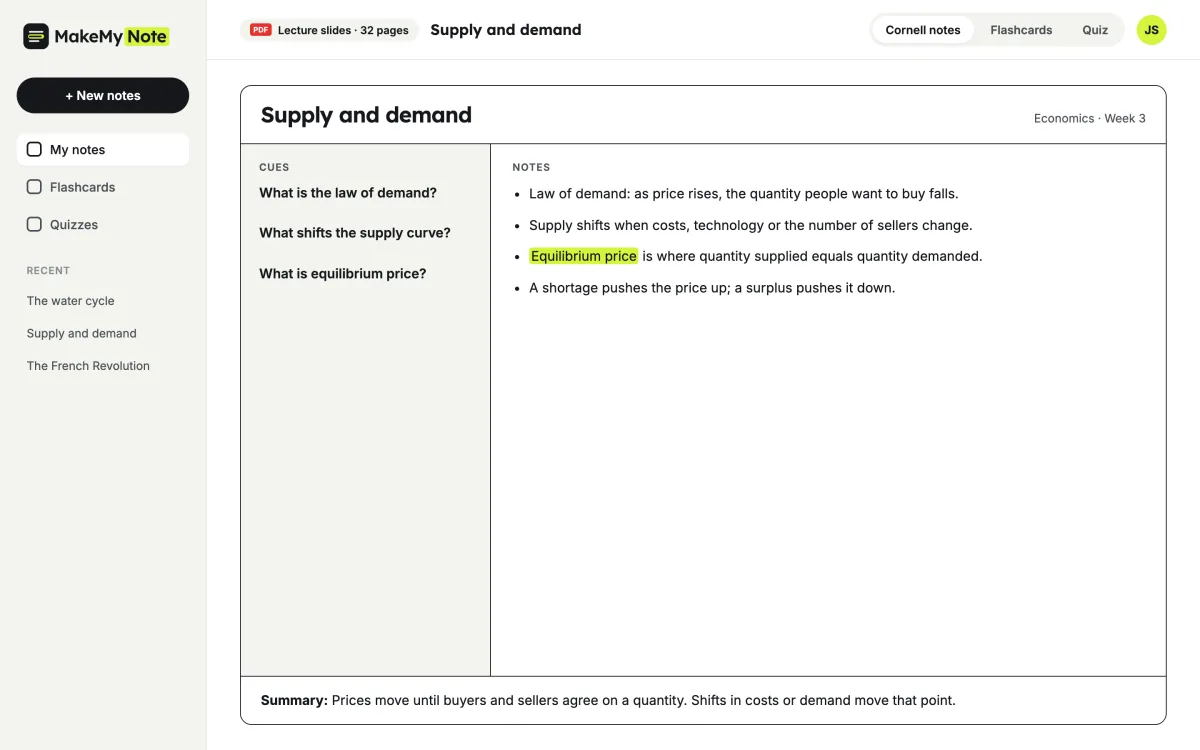
- Cue: What is the law of demand? Note: As price rises, the quantity people want to buy falls.
- Cue: What shifts the supply curve? Note: Changes in costs, technology or the number of sellers.
- Cue: What is equilibrium price? Note: The price where quantity supplied equals quantity demanded.
- Summary: Prices move until buyers and sellers agree on a quantity. Shifts in costs or demand move that point.
How to study with Cornell notes
This is where the method really pays off.
- Cover the right column with a sheet of paper.
- Read each cue question and answer it out loud.
- Uncover the notes and check your answer.
- Mark any cue you got wrong and come back to it tomorrow.
This is called active recall: pulling information out of your memory instead of just reading it again. It feels harder than rereading, but it is one of the most reliable ways to remember what you study. We explain it in more detail in our guide to active recall with flashcards.
When to use Cornell notes
- Lectures and classes with lots of new ideas.
- Reading chapters you will be tested on.
- Subjects with many definitions, like biology, economics or law.
For quick revision the night before a test, a one-page revision sheet may suit you better. For problem-heavy subjects like maths, a worked-examples notebook often works best.
Save time with a Cornell notes generator
Writing good cue questions takes practice. If you want a head start, the MakeMyNote Cornell notes generator turns a YouTube class, PDF or set of slides into Cornell notes with the cues, notes and summary already written. Then you can spend your time on the most useful part: testing yourself.