
Most students revise by reading their notes again and again. It feels productive, because everything looks familiar. But familiar is not the same as remembered. In the exam, there are no notes to look at.
Active recall fixes this. Instead of reading information, you practise pulling it out of your memory. Flashcards are the easiest way to do it. Here is how to use active recall with flashcards so that what you study actually sticks.
What is active recall?
Active recall means testing yourself before you look at the answer. When you try to remember something, even if you struggle, your brain strengthens the path to that memory. Every time you recall it, it gets a little easier the next time.
Rereading skips this step. You see the answer straight away, so your brain never has to work for it.
How to write good flashcards
A flashcard is only as good as its question. Keep these rules in mind:
- One fact per card. “What are the four stages of the water cycle?” is better split into four cards.
- Ask a real question. “What does the nucleus do?” works better than just “Nucleus”.
- Keep answers short. If the answer is a paragraph, the card is too big.
- Use your own words. Copying the textbook word for word makes cards harder to remember.
- Add an example when you can. Examples make abstract ideas easier to recall.
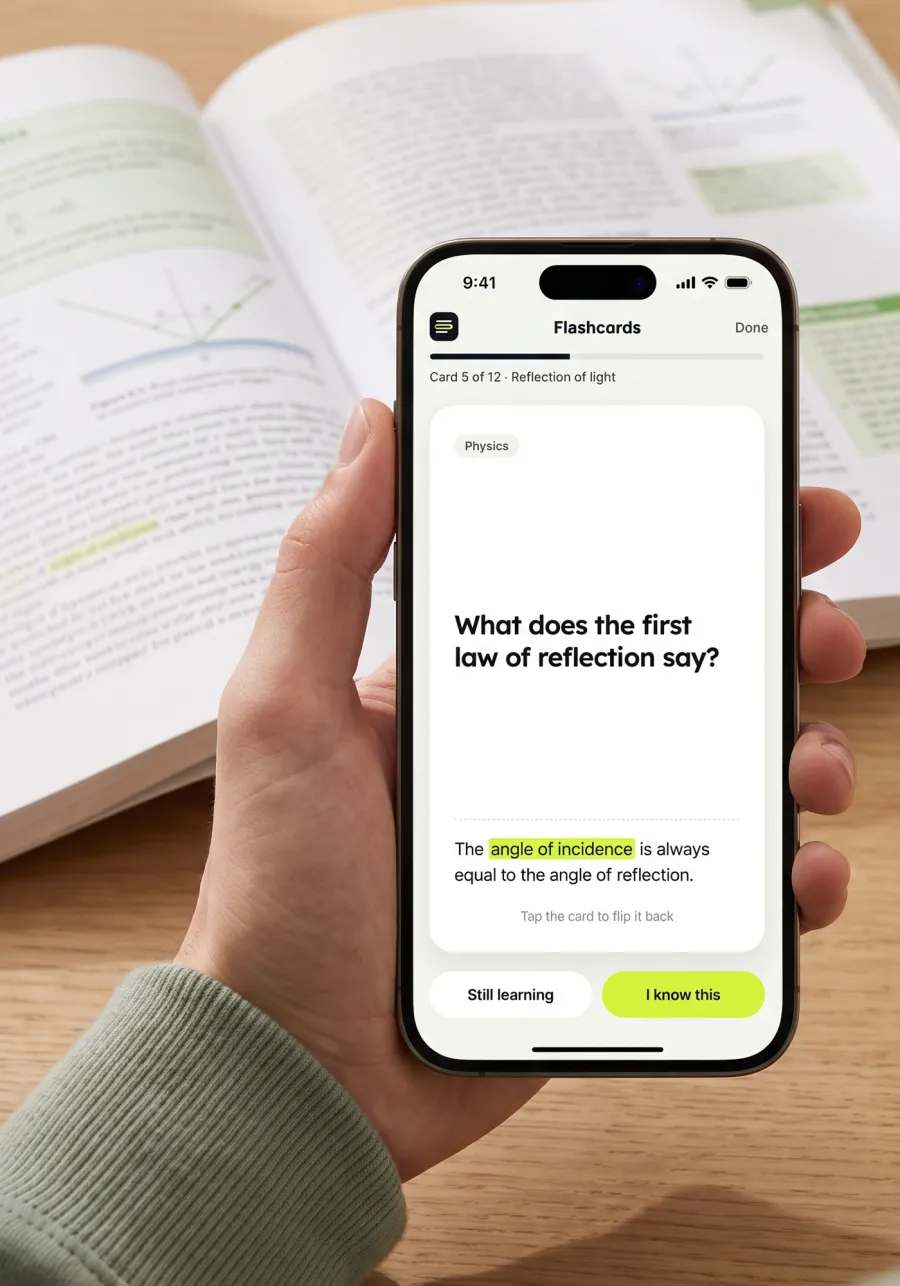
Example: Front: “What does the first law of reflection say?” Back: “The angle of incidence equals the angle of reflection.”
How to study with flashcards
- Read the question and answer it in your head or out loud. Commit to an answer before you flip.
- Flip and check. Be honest. Almost right is not right.
- Sort the card. Put it in “I know this” or “Still learning”.
- Repeat the “still learning” pile until you get each one right.
Space it out
Reviewing everything the night before a test works for that test, but it fades fast. Spacing your reviews over days and weeks helps you remember for much longer. A simple plan:
- Review new cards the day after you make them.
- Then again a few days later.
- Then once a week until the exam.
Cards you keep getting right can be reviewed less often. Cards you keep getting wrong should come up more. Many flashcard apps do this scheduling for you.
Common mistakes to avoid
- Making cards and never reviewing them. Writing cards is not studying; answering them is.
- Flipping too fast. Give yourself a few seconds to really try.
- Only studying the cards you know. The hard pile is where the learning is.
- Too many cards at once. Twenty minutes a day beats three hours once a week.
Make flashcards from your notes in seconds
Writing flashcards by hand takes time. MakeMyNote creates flashcards and a short practice quiz from your own notes, whether they come from a YouTube class, a PDF or a photo of your notebook. You can review them on your phone and sort each card into “I know this” or “Still learning”.
However you make them, the rule is the same: test yourself before you look. That small habit makes a big difference.